
A leading Chinese scholar has demanded that India should make its atomic programme"transparent" and questioned its status as a legitimate nuclear weapon state, in a commentary that comes in the midst of intense media focus on reports of Chinese incursions along the border.

Chief of Defence Staff General Anil Chauhan emphasized the need for constant high military preparedness, citing Operation Sindoor as an ongoing example. He also highlighted the importance of 'information warriors, technology warriors and scholar warriors' in future warfare.
About 4 GW of new nuclear power capacity is under construction in India
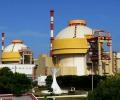
'Decisions on nuclear power have so far been taken by a small select group, primarily interested in profiteering from their actions, stating 'secrecy' as necessary from the national security point.' 'This argument is false, because we are dealing with the 'civilian' nuclear power sector, which is open even to the IAEA,' says Dr A Gopalakrishnan, former chairman of the Atomic Energy Regulatory Board.
India's civil nuclear liability regime has raised serious questions about the country's capacity addition programme. In an interview with Sanjay Jog, G R Srinivasan, former vice-chairman of the Atomic Energy Regulatory Board and currently principal associate-nuclear power business in GMR Energy Ltd, says the regime is tremendously unbalanced and may adversely affect the nuclear capacity addition programme.

India and Pakistan are reportedly expanding their nuclear arsenal, despite a global trend towards disarmament, the Stockholm International Peace Research Institute has said.

Russia and China are 'seriously' considering a project to install a nuclear reactor on the Moon in the next decade, the official media in Moscow quoted the head of the Russian space corporation as saying.

"After all, you are the only leader who has taken a bold and courageous stand against the Haripur nuclear project in Purba Medhinipur district in West Bengal," People's Movement Against Nuclear Energy (PMANE), sprearheading the stir said in a letter to Banerjee.
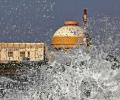
This would make India the world's second-biggest nuclear energy market after China
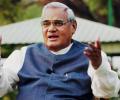
It was good fortune for India to have Atal Bihari Vajpayee lead the government at a crucial moment in our history. He avoided India meeting the fate of Iraq or Ukraine, asserts military historian Colonel Anil A Athale (retd).
Shunned for decades for refusing to relinquish its nuclear weapons programme, India was finally welcomed as a member of the global nuclear club last year when the US dropped long-standing sanctions.

The idea of weaponization got a fillip from an unexpected quarter. In the last week of October 1985, Rajiv met US President Ronald Reagan. Reagan told Rajiv, 'Pakistan has already made a bomb.' When Rajiv started talking about disarmament, the US president cut him short, 'Don't talk theory, think of your own protection.'

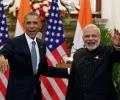
Obama seeks reduction of nuclear arsenal in India and Pakistan while Pakistan seeks NSG membership
The sanctions imposed by developed countries, coupled with lack of political will have deprived India of optimal growth in the nuclear power sector, according to senior nuclear scientists.
Union minister Jitendra Singh assured the members of the Rajya Sabha on Thursday that there is better nuclear safety in India as compared to many other countries and there are enough safeguards in the Indian nuclear plants.
Atomic Energy Commission (AEC) Chairman Anil Kakodkar has said work on India's nuclear programmes will continue despite media reports of the country's nuclear power plants being placed on alert and being made more secure to prevent a terror strike.
He was also opposed to displacement of communities as a whole and their replacement by others and sought to differentiate between Zionism and Jews.

Prime Minister Narendra Modi on Friday said the world has seen the power of India's indigenous weapons during Operation Sindoor, which is 'not over yet'.

On the eve of the most crucial round of talks between Iran and the world powers, the United States has said that Tehran has a choice to make in the coming weeks to address concerns about its military nuclear programme.
Russia also welcomed the separation plan of military and civilian nuclear programmes and India's compliance with non-proliferation norms.

Since $4-5 billion (Rs 18,670-23,340 crore) will be needed to set up each nuclear reactor, capital costs alone add up to $200-250 billion (Rs 9,33,600-11,67,000 crore). Then there are fuel costs, nuclear waste disposal, reprocessing, consultants & advisors and, of course, the financial market aspects of raising all that money.
Areva, the French nuclear group, agreed on Wednesday to supply India with up to six nuclear reactors in one of the first deals since the subcontinent's nuclear programme was brought into the international fold last year after decades of isolation.

China's official media on Tuesday went public over India's Nuclear Suppliers Group bid for the first time, saying New Delhi's membership of the elite club will not only touch a "raw nerve" in Pakistan and increase a nuclear arms race in the region but also "jeopardise" China's national interests.

The Final Reckoning, with all its startling ambition and scope, puts a dazzling display of stunt-work by Tom Cruise, applauds Mayur Sanap.

'There's a lot of sense in what Prime Minister Modi did, but the Indian government has to be really prepared for a really sharp escalation spiral.'
An inconclusive end to this war will pose high risk for Netanyahu of a cascading demand for a regime change in Israel, predicts Ambassador M K Bhadrakumar.

Amidst ongoing tensions with the ruling DMK government, Tamil Nadu Governor R N Ravi has invited Vice President Jagdeep Dhankar to inaugurate a meeting of state university Vice Chancellors in the Nilgiris district, sparking criticism from political parties, particularly the Left, who have urged a boycott. The meeting comes in the wake of the Supreme Court ruling in favor of the Tamil Nadu government regarding the appointment of Vice Chancellors, which has stripped the Governor of his previous authority as Chancellor. The Governor, however, maintains his right to convene the meeting, highlighting the ongoing power struggle between the Governor and the state government. The meeting is scheduled for April 25 and 26.
Pakistan Friday said it plans to generate 8,800 MW of nuclear power by 2030 and maintained that its nuclear programme was for peaceful purposes.

India had enough weapons-grade plutonium by 2014 to possess an estimated arsenal of 75 to 125 nuclear weapons, according to a prominent US-based think-tank.

'Once the military starts to draw up plans for using nuclear weapons, then nuclear weapons could be used earlier in a crisis than otherwise.'

AQ Khan, a controversial scientist known as the father of Pakistan's clandestine nuclear programme, passed away here on Sunday after a brief illness. He was 85.
India is determined that its expanded nuclear power programme will follow the highest standards of nuclear safety and security, Prime Minister Manmohan Singh said while addressing the Nuclear Security Summit in Seoul on Tuesday.
The Bharatiya Janata Party, if voted to power, will "revise" the country's nuclear doctrine to make it "relevant to challenges of current times", said the party manifesto while talking about maintaining the credible minimum deterrent in tune with the "changing geostatic realities".

The feud reached its peak when Musk made explosive allegations about Trump's connection to disgraced financier Jeffrey Epstein, marking a dramatic escalation in their increasingly personal conflict.
"I have tried to be a friend to India. But, as long as there is breath in me, I will never support the lifting of the Glenn amendment sanctions on India unless they abandon all nuclear ambitions."

Pitching for greater use of "clean" and "dependable" nuclear power, Prime Minister Manmohan Singh on Monday made it clear that India will need large amount of energy to maintain the tempo of growth which averaged 7.9 per cent during the last 10 years despite two bouts of global recession.
India's strong nuclear programme, with comprehensive capability for the entire nuclear fuel cycle and the strong technical support from Bhabha Atomic Research Centre and Indira Gandhi Centre for Atomic Research, were highly appreciated, according to Chairman of Atomic Energy Regulatory Board S K Sharma, who led the 17 member high-level Indian delegation. India presented its 206-page report for the first time that included the effective regulatory mechanism for power plants.
Pushing ahead with the controversial Jaitapur atomic power plant, government on Wednesda said it has decided to have a stand-alone safety system in the designs of each reactors, two of which are expected to be operational by 2019 and announced a bill would be brought to create an autonomous nuclear regulatory body.

India has said it is committed to implementing the highest safety standards at its nuclear power plants as it seeks to harness the benefits of atomic energy to meet its growing energy requirements.
